Applied AI · EdTech · Experience Architecture · Governance
AI Conversation Integration
Client: City of london corporation
Year: 2026
Role: Solution Strategy, Experience Architecture, Technology Evaluation, Governance & Implementation Planning

Challenge / Context
This project explored how conversational and emotive AI could be introduced into manager development selectively rather than indiscriminately.
The objective was not to replace established digital learning with an AI interface. It was to determine where different technologies could improve emotional preparedness, judgement and behavioural rehearsal while preserving the deterministic controls required by a large public-sector organisation.
The resulting proposal separated the experience into four complementary functions: assurance, emotional exposure, recognition and sense-making, and behavioural practice.
The Approach
Traditional digital learning can scale effectively for policy and information, but is less able to reproduce the ambiguity and emotional pressure of difficult human conversations.
That made the design problem broader than selecting an AI vendor.
The system needed to balance realism with scalability, experimentation with governance, psychological safety with useful feedback, and emerging technology with formal organisational requirements.
Those tensions became explicit design principles: compliance should remain deterministic where required, reflective activity should remain psychologically safe, and AI should only be introduced where it added a capability that conventional learning could not provide effectively.

Formal learning platform and system of record



Expressive, emotionally realistic audio
I developed a four-stage model in which each technology had a deliberately different role.
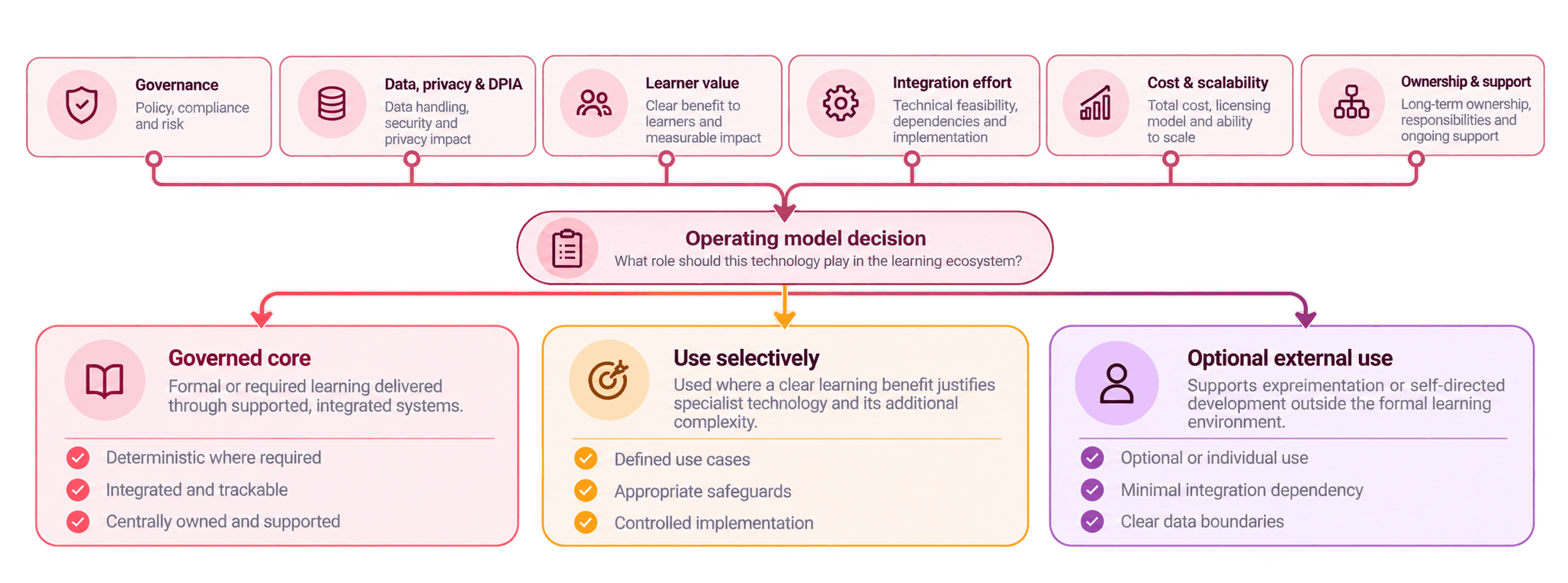
A major part of the work was deciding where different technologies were actually appropriate.
Virti was considered against requirements including judgement-based conversational practice, low-overhead ownership, scalable learner access, governance and the ability to operate as a complementary practice environment. Alternatives including Yoodli, Synthesia, Convai and different avatar/voice approaches were considered against the wider experience rather than treated as isolated products.
Technical discovery also considered routes including LMS integration, LTI 1.3, OAuth-based access, domain restrictions, SSO and DPIA implications. The proposed pilot deliberately avoided making deep LMS integration a prerequisite. SAP would remain the formal learning system, while the practice layer could operate separately unless evidence from the pilot justified deeper integration.
I modelled vendor and usage costs, internal delivery effort, scaling behaviour, concurrency, governance requirements, data risks, implementation dependencies, responsibilities and potential controls. Virti in particular was assessed as a capability whose economics change significantly depending on whether it is offered selectively or mandated at scale.
Risk analysis covered usage-driven cost escalation, learner access, the risk of learners interpreting AI practice as assessment, third-party data handling, DPIA and procurement friction, and the distinction between completion tracking and behavioural scoring.
Outcome
The output was a decision-ready implementation proposal, not a claim of full enterprise deployment.
It defined the experience architecture, technology roles, learner journeys, integration options, governance boundaries, cost behaviour, implementation effort, responsibilities and key risks required to evaluate a realistic pilot.
Experience architecture · Integration strategy · Cost & scaling model · Governance framework · Pilot implementation plan
Return home