Healthcare Education · Immersive Technology · VR/AR · Experience Design
Immersive Medical Education
Client: NHS
Year: 2025
Role: Creative Director — Creative & Experience Direction, Product UX, Immersive Learning, 3D/Visual Direction, Partner Collaboration

PArtners & Collaborators


Challenge / Context
Medical Realities explored a difficult access problem: how could medical students gain meaningful exposure to clinical environments and expert teaching that are inherently difficult to scale?
Operating theatres, laboratories and specialist procedures are constrained environments. Only limited numbers of students can attend physically, learners cannot always observe from the ideal position, and access to specialist teaching varies between institutions and regions.
As Creative Director, I worked across the development of the company’s immersive-learning proposition, shaping how 360° clinical footage, interactive content, spatial interfaces and emerging VR technology could become a usable educational experience rather than simply a new way of watching video.
The Approach
The opportunity in VR was not merely to reproduce conventional medical footage inside a headset.
A 360° environment could preserve the wider clinical context: the surgeon, assistants, equipment, communication and activity around a procedure remained available to the learner rather than being reduced to a single directed frame.
The design challenge was therefore to determine what immersion genuinely contributed to learning and how anatomy, procedural information, supporting content and assessment could be layered into that environment without overwhelming it.
The platform developed towards nonlinear immersive training modules that combined real clinical footage with structured educational content across different levels of VR hardware.
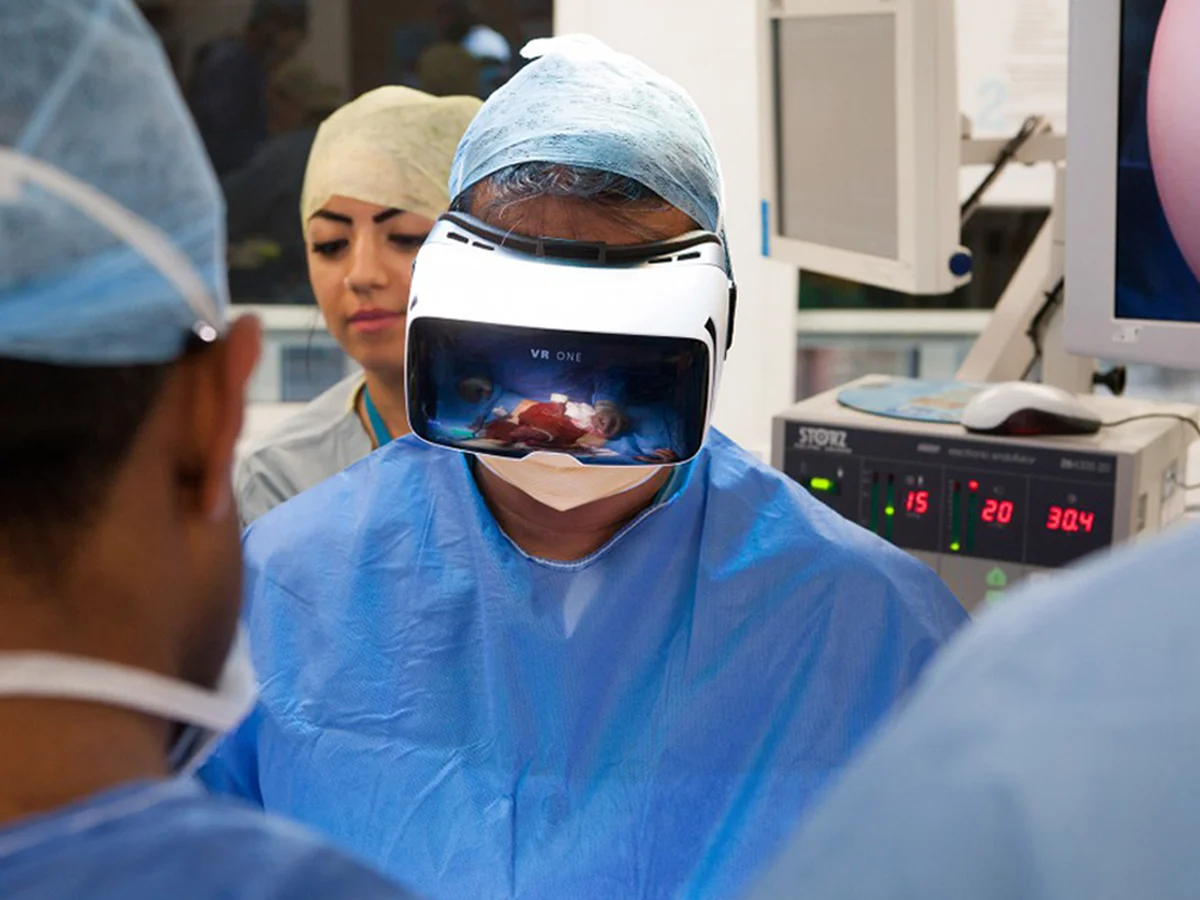
One of the defining projects came in 2016, when Medical Realities worked with Barts Health NHS Trust and Mativision to broadcast the world’s first live surgical procedure in 360° VR from the Royal London Hospital.
I helped lead the creative and experiential side of the project, including how the operating theatre would translate into a 360° learning environment and how camera positioning could provide useful presence without interfering with the clinical team.
The procedure was watched live by approximately 55,000 people across 140 countries.
The technology was deliberately accessible: viewers could participate through comparatively inexpensive smartphone VR such as Google Cardboard as well as more capable headsets and conventional screens. The objective was access and scale rather than technological exclusivity.
The livestream demonstrated that immersive clinical access could reach an audience impossible to accommodate physically, but the larger product challenge was what happened after the novelty of being present wore off.
The platform evolved towards structured learning experiences combining 360° operations with instructional content, interactive overlays, clinical information and opportunities to test understanding.
That distinction mattered. A compelling VR recording could create presence; an educational product needed to provide context, progression and learning structure.
The work therefore sat between several disciplines: learning design, product UX, spatial experience, clinical content and emerging-technology production.
The same underlying principle — using immersive media to provide access to environments that are difficult to experience physically — was subsequently applied more broadly through institutional partnerships.
Work with the Leeds Institute of Medical Education and Leeds Teaching Hospitals Trust included an immersive histopathology laboratory experience in which students could move through different stages of testing and diagnosis, access contextual information and hear teaching from subject specialists.
The project showed how immersive media could support education beyond spectacular one-off events by addressing routine access constraints in real teaching environments.
This work took place when consumer VR was still technically immature.
Hardware ranged from Google Cardboard and Gear VR to tethered Oculus systems; mobile processing, image quality, streaming bandwidth and interaction capabilities imposed significant constraints.
That made the work as much about understanding the limits of an emerging medium as exploiting its strengths.
The question was never simply:
Can we put this in VR?
It was:
Where does immersion provide access or understanding that conventional media cannot — and how do we design around the limitations of the technology available?
Outcome
The work progressed from early 360° experimentation into practical immersive-learning resources used with NHS and university partners.
The 2016 live VR surgery reached approximately 55,000 viewers across 140 countries, demonstrating the potential for immersive media to extend access to specialist clinical environments far beyond the physical operating theatre. Mynewsdesk
That principle was later applied more directly to teaching through the University of Leeds partnership. Its virtual histopathology experience enabled a cohort of 270 students to access a clinical environment that physical tours could accommodate only four students at a time. A process requiring around 67 hours of staff-guided visits each year was converted into a 36-minute flexible VR learning experience, which was also used for remote teaching during the pandemic. xrhealthuk.org
For me, the enduring value of the work was demonstrating a principle that has remained central to my practice: emerging technology becomes useful when it solves an access, learning or experience problem rather than existing for its own sake.
55,000 LIVE VIEWERS · 140 COUNTRIES · 270-STUDENT LEEDS COHORT · 67 HOURS OF GUIDED ACCESS → 36-MINUTE VR EXPERIENCE

Return home