City of London Corporation · Operating Model Design · Digital Operations · Governance

Hybrid Digital Delivery Workflow

Client: City of london corporation

Year: 2026

Role: Workflow Architecture, Operating Model Design, Governance & Team Enablement

Challenge / Context

Shadow Agile was created to address an operational problem rather than a technology problem.

Digital work was being delivered, but the system around that delivery had developed informally. Requests could enter through several channels, priority and sequencing were not consistently visible, ownership could be assumed rather than recorded, and support issues were handled inconsistently.

I identified the need for a coherent delivery model, designed the workflow and governance approach and created the request, guidance, tracking and support artefacts required to make it usable in practice.

The Approach

From workflow to operating model

From workflow to operating model

From workflow to operating model

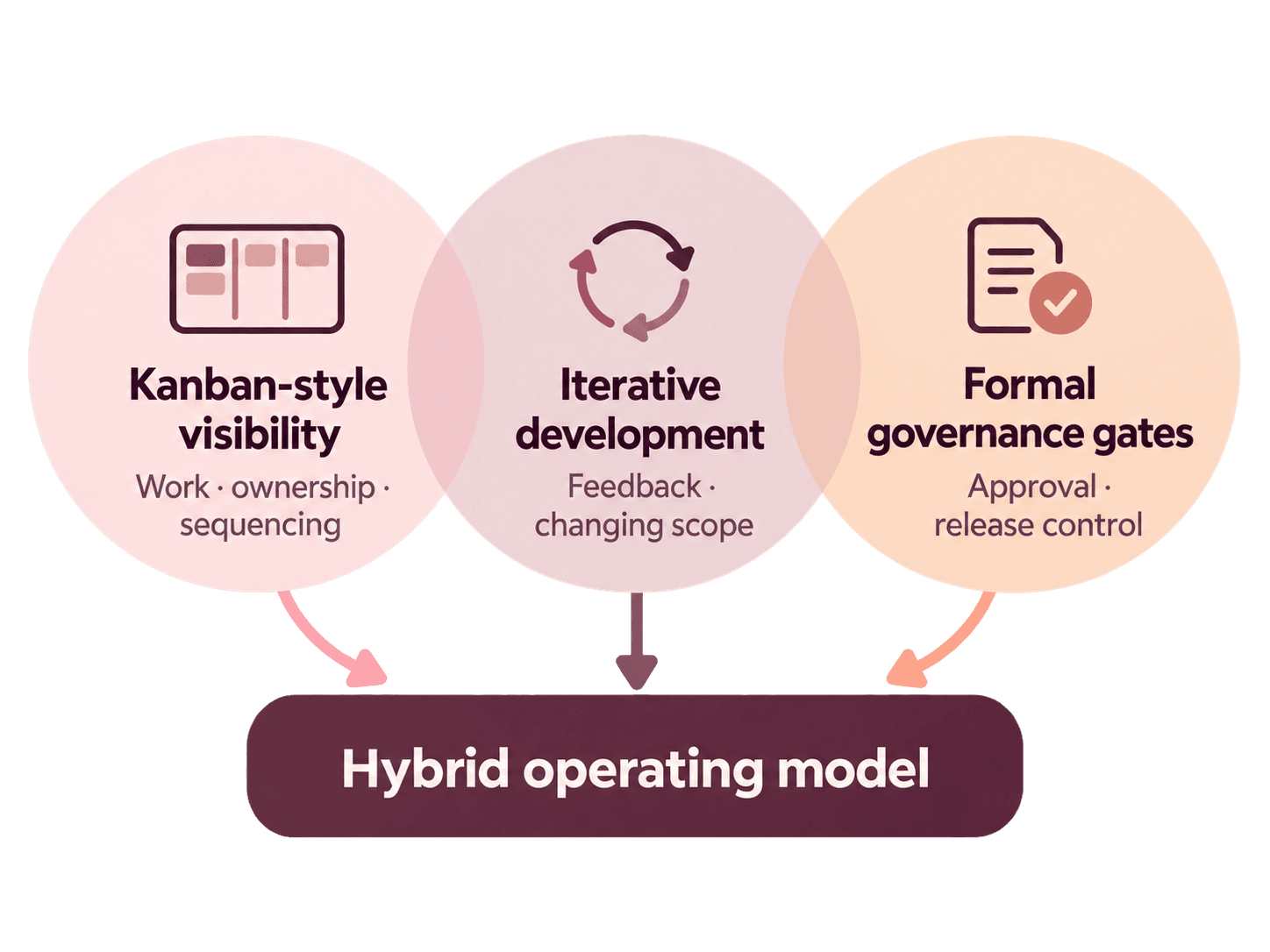
The team had to manage concurrent demand, different project sizes, changing priorities, iterative stakeholder feedback, formal approval requirements, SAP/LMS dependencies and issues that continued after release.

The team had to manage concurrent demand, different project sizes, changing priorities, iterative stakeholder feedback, formal approval requirements, SAP/LMS dependencies and issues that continued after release.

A hybrid approach

The operating model combined selected practices to match the realities of delivery, governance and support.
From workflow to operating model

From workflow to operating model

From workflow to operating model

The resulting lifecycle covered:

request → structured intake → governance and prioritisation → delivery → approval and release → live support → review

Underneath that flow sat the practical infrastructure required to make it repeatable: Microsoft Planner, a SharePoint Course Tracker, designer and SME guidance, governance forms, support records and SAP/LMS information.

The point was not to introduce another tool. It was to create a shared operating system across tools, decisions and people.

Delivery Lifecycle

Operating Infrastructure

01

Request

Work enters through a defined route.

01

Request

Work enters through a defined route.

01

Request

Work enters through a defined route.

Request guidance

02

Structured intake

Policy, responsbilities and baseline understanding

02

Structured intake

Policy, responsbilities and baseline understanding

02

Structured intake

Policy, responsbilities and baseline understanding

Intake / governance forms

03

Governance & prioritisation

Work is assessed, sequenced and routed appropriately.

03

Governance & prioritisation

Work is assessed, sequenced and routed appropriately.

03

Governance & prioritisation

Work is assessed, sequenced and routed appropriately.

Microsoft Planner
SharePoint Course Tracker
Governance records

04

Delivery

Work develops iteratively with SME and stakeholder input.

04

Delivery

Work develops iteratively with SME and stakeholder input.

04

Delivery

Work develops iteratively with SME and stakeholder input.

Designer guidance
SME guidance

05

Approval & release

Required checks and approvals are completed.

05

Approval & release

Required checks and approvals are completed.

05

Approval & release

Required checks and approvals are completed.

Governance records
SAP / LMS information

06

Live support

Post-release issues and changes follow a documented route.

06

Live support

Post-release issues and changes follow a documented route.

06

Live support

Post-release issues and changes follow a documented route.

Support records

07

Review

Learning and decisions feed back into future delivery.

07

Review

Learning and decisions feed back into future delivery.

07

Review

Learning and decisions feed back into future delivery.

Tracker / documented history

Governance without heavyweight process

Governance without heavyweight process

The model established a consistent intake route, explicit ownership, clearer review points and a documented route for support after release.

Mandatory or regulated work could trigger additional challenge and approval before entering delivery, while material late changes could be re-scoped rather than simply absorbed.

This kept the model flexible enough for small tasks while providing more explicit structure for larger or higher-risk work.

Adoption and value

Shadow Agile was used by the four-person Digital Team, including an apprentice, and elements were later adapted for wider L&OD use, including trainer workflows.

Its value was therefore not an unsupported claim of quantified productivity improvement. It was the creation of shared visibility, clearer ownership, repeatable governance, better operational continuity and reusable guidance.

Shared Visibility

Shared Visibility

Clearer Ownership

Clearer Ownership

Responsible Governance

Responsible Governance

Operational Continuity

Operational Continuity

Reusable Guidance

Reusable Guidance

Return home

Contact

For considered work at the edge of technology, systems and experience.

James Pendry — Creative Technology & Digital Innovation

Contact

For considered work at the edge of technology, systems and experience.

James Pendry — Creative Technology & Digital Innovation

Contact

For considered work at the edge of technology, systems and experience.

James Pendry — Creative Technology & Digital Innovation